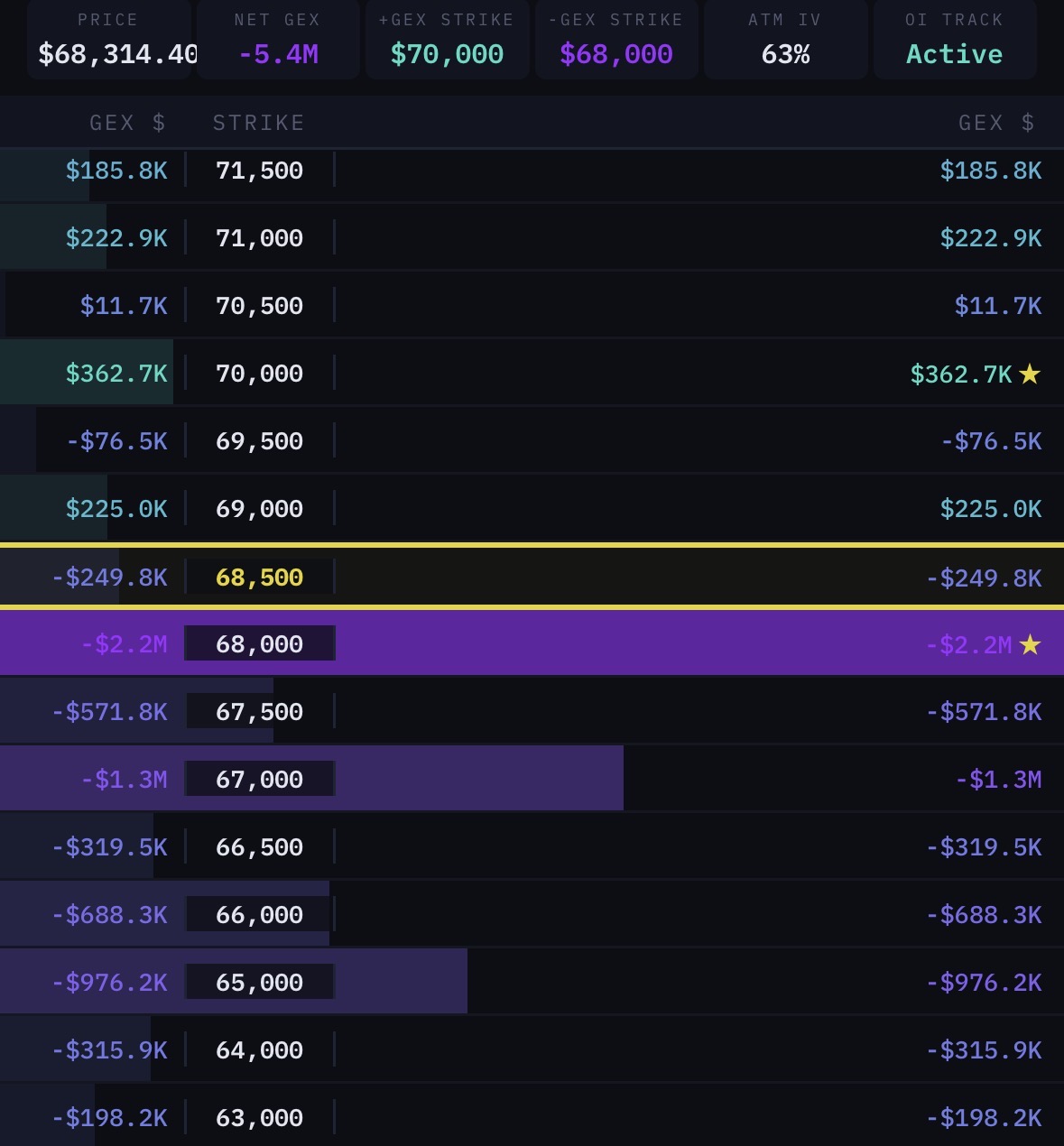
📊 What is GEX?
GEX — short for Gamma Exposure — measures the total dollar-weighted gamma that market makers (dealers) hold across all strike prices for a given underlying asset.
In plain terms, GEX tells you how much buying or selling pressure dealers will generate through hedging when the price of the underlying moves. It translates the abstract concept of "gamma" into a concrete dollar amount that represents real market impact.
GEX is also referred to as Gamma Notional or Net Gamma Notional — these terms are interchangeable.
🧱 Building Blocks: From Payoff Diagrams to GEX
To understand GEX, you need to understand four concepts in sequence: options payoffs → delta → gamma → dealer hedging.
Options Payoff Recap
A call option gives the buyer the right to buy at a fixed price (the strike). The payoff diagram shows zero below the strike, then rises at 45° above it.
A put option gives the buyer the right to sell at a fixed price. The payoff diagram shows zero above the strike, then rises at 45° below it.
The slope of the payoff curve at any point is the option's delta.
Delta: Sensitivity to Price
Delta measures how much an option's price changes when the underlying moves $1. Dealers who hold options must hedge their delta exposure by taking an offsetting position in the underlying. This is called delta hedging.
| Option State | Call Delta | Put Delta |
|---|---|---|
| Deep OTM | ~0 | ~0 |
| ATM | ~0.5 | ~−0.5 |
| Deep ITM | ~1.0 | ~−1.0 |
Gamma: How Fast Delta Changes
Gamma is the rate of change of delta with respect to the underlying price. If delta is speed, gamma is acceleration.
- Gamma is always positive for option holders (both calls and puts)
- Gamma is highest at ATM and decreases as price moves away
- Gamma is higher for shorter-dated options
Dealer Hedging: Where GEX Comes From
When a dealer holds an options position, they must continuously adjust their hedge in the underlying as the price moves. The direction and magnitude of this adjustment depends on their gamma. This continuous re-hedging across thousands of contracts and strikes creates significant buying and selling pressure. GEX quantifies this pressure.
⚙️ How GEX is Calculated
At each strike price, GEX is calculated as:
Strike GEX = Gamma × Dealer Position × 100 × Spot Price²The sign convention is determined by the dealer's position:
- Dealer is long (bought) the option → positive (+) GEX
- Dealer is short (sold) the option → negative (−) GEX
This is true regardless of whether the option is a call or a put. Gamma is always positive for option holders — what determines the sign of GEX is whether the dealer bought or sold the contract.
NET GEX is the sum of all individual strike GEX values:
NET GEX = Σ (Long GEX) + Σ (Short GEX)📈 Interpreting NET GEX
The interpretations below describe the dealer-hedging dynamics that emerge when dealers actually hold the positions implied by Market GEX. In practice, this is the most common case, but the strength of these effects varies with how closely actual dealer positioning matches the inference.
Positive NET GEX — Dealers Net Long Gamma
When Market NET GEX is positive — and dealers are net long gamma — the combined effect of dealer hedging tends to suppress volatility:
| Price Action | Dealer Response | Market Effect |
|---|---|---|
| Price rises | Dealers sell underlying | Caps upside |
| Price falls | Dealers buy underlying | Supports downside |
Typical result: Price tends to be pulled toward equilibrium. Markets often feel "pinned," choppy, or range-bound. Environment for mean-reversion strategies and premium selling.
Negative NET GEX — Dealers Net Short Gamma
When Market NET GEX is negative — and dealers are net short gamma — the combined effect of dealer hedging tends to amplify volatility:
| Price Action | Dealer Response | Market Effect |
|---|---|---|
| Price rises | Dealers buy underlying | Pushes price higher |
| Price falls | Dealers sell underlying | Pushes price lower |
Typical result: Price often accelerates in both directions. Markets can trend hard, breakouts may sustain, and liquidation cascades become more likely. Environment for momentum and trend-following strategies.
🧭 Key GEX Levels
+GEX Strike
The strike with the largest positive GEX value. This is the level where dealer hedging exerts the strongest stabilizing influence. Price tends to gravitate toward this level, especially near expiration.
−GEX Strike
The strike with the largest negative GEX value. This is the level where dealer hedging has the strongest destabilizing potential. Price interacting with this level tends to produce volatile, "wicky" moves with potential for overshoot and reversal.
The Gamma Flip Point
The price level where NET GEX transitions from positive to negative (or vice versa). Above this level, dealer hedging stabilizes price; below it, dealer hedging destabilizes.
⚠️ Limitations of GEX
- Open Interest ≠ Dealer positioning. OI tells us how many contracts exist, not who holds them or in which direction.
- GEX is a snapshot. Positioning changes throughout the day as new trades are executed and existing positions are closed.
- Model sensitivity. Different GEX models can produce different values depending on how they estimate gamma, handle expirations, and apply the sign convention.
- GEX does not predict direction. It predicts the character of price movement (smooth vs. volatile, pinned vs. trending) rather than the direction.
📚 Key Takeaways
- GEX = Gamma × Dealer Position × 100 × Spot², summed across all strikes
- Positive NET GEX → stabilized, low-volatility, pinned market
- Negative NET GEX → amplified, high-volatility, trending market
- The +GEX strike acts as a price magnet; the −GEX strike acts as an accelerant
- GEX is context, not signal — always confirm with price action
- Market GEX is inference, not observation. It maps the gamma landscape implied by open interest, but actual dealer positioning may differ. Pair it with price action and other context.
📘 Note: Two Views of GEX — Market vs. Dealer
The mechanisms described in this chapter (positive gamma → stabilization, negative gamma → amplification) operate most precisely when dealer positions are directly known. This direct view is referred to as Dealer GEX.
However, options exchanges generally do not disclose dealer-level positioning. What can be derived from publicly available open interest (OI) data is an estimate of the market-wide gamma distribution — this is called Market GEX, and it is what GEXFlow currently provides.
Market GEX is a powerful map of the market's overall gamma landscape, but it is an inference, not a direct observation of dealer intent. Keep this distinction in mind as you read.
Direct Dealer GEX observation is planned for a future Pro tier release.